Bibliography
Sources we've worked from.
Every book, dissertation, and article that informs the site. The first list — works we hold and have read — drives most of the cited material in /research, /glossary, the maâlem profiles, and the tab repertoire. The second list — works our held sources cite repeatedly — is honest about what's second-hand on the site.
Counts: 19 works held and cited directly; 14 further works referenced through them.
Book(8)
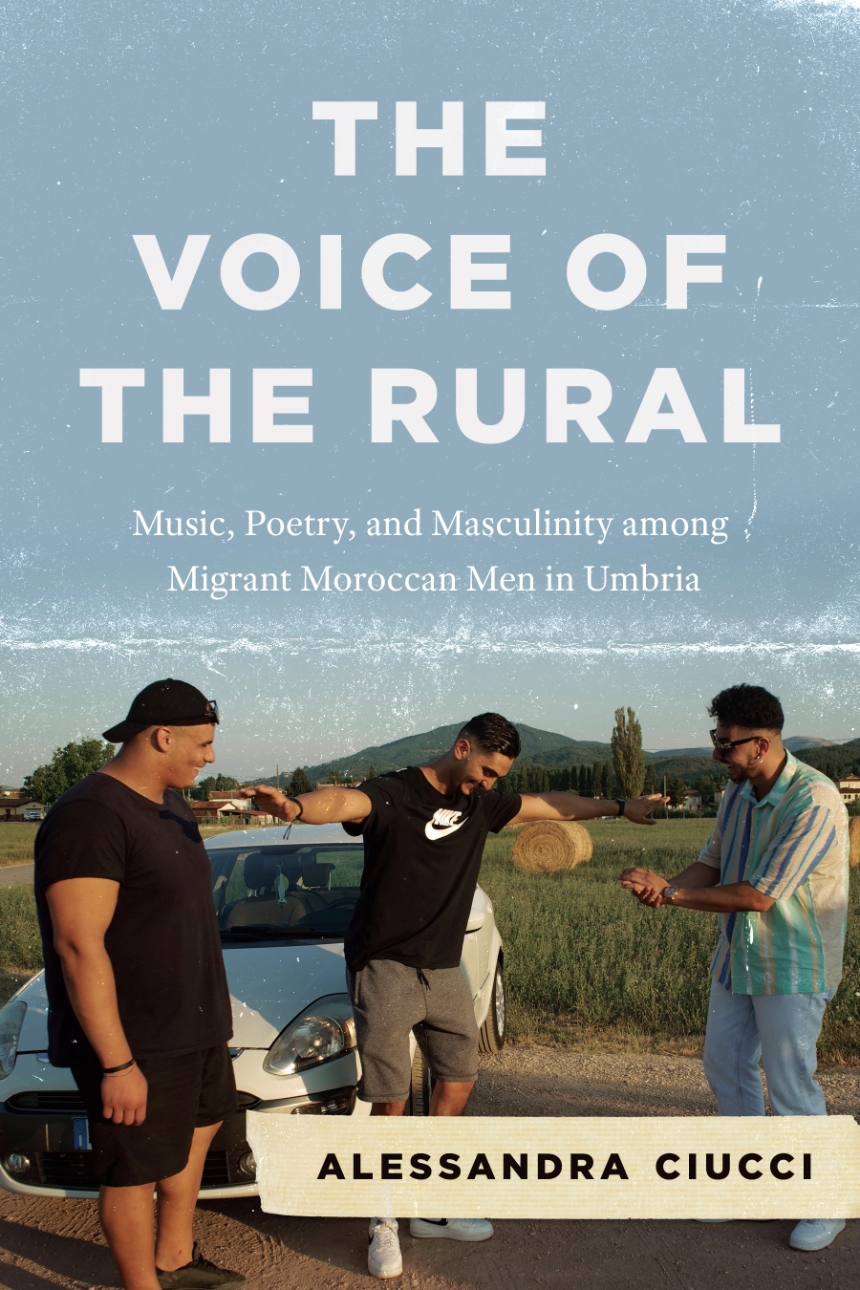
The Voice of the Rural: Music, Poetry, and Masculinity among Migrant Moroccan Men in Umbria
Ciucci, Alessandra · 2022 · University of Chicago Press (Chicago Studies in Ethnomusicology)
ISBN: 978-0-226-81869-6
Comparative reference. Not directly about the Gnawa; on l-'arubiya — the rural music and poetry of Moroccan men, as performed in the migrant diaspora in Umbria, Italy. Held on the project shelf because Aidi 2023 reviews it alongside Becker, El Hamel, and Witulski.
Full summary
Four chapters on Moroccan men's rural music and poetry, the gendered category l-'arubiya, and how migrant performers in Italy voice their longing for Morocco through this repertoire. Of indirect interest to the Gnawa project — illuminates the broader Moroccan musical landscape and the same festival-economy / authenticity questions Witulski poses for the Gnawa.
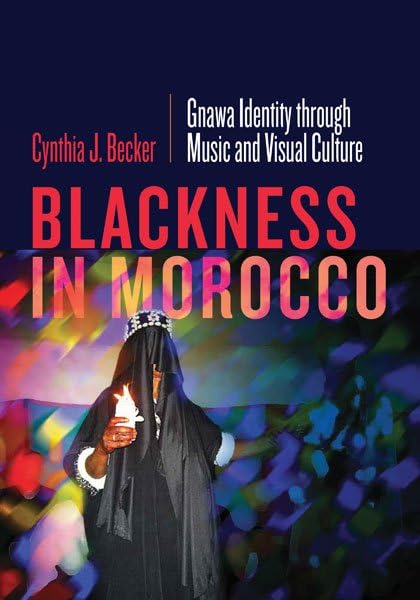
Blackness in Morocco: Gnawa Identity through Music and Visual Culture
Becker, Cynthia J. · 2020 · University of Minnesota Press
ISBN: 978-1-517-90939-0
The first book-length treatment of Gnawa visual culture — costumes, regalia, patchwork gowns, photography — alongside the music. Argues that 'Gnawa' is a constructed Black identity uniting people through cultural and political understandings of Blackness rather than through biological descent.
Full summary
Field-based study built from Becker's annual Essaouira fieldwork since 1997 (year-round since 2006). The book reads Gnawa identity as a patchwork — explicitly modeled on the Bu Derbala/Buderbala spirit's multicoloured costume — that absorbs people from many ethnic origins into a shared Black identity. Becker's gateway was Khamlia, a remote southeastern town inhabited by the Ismkhan ('slaves'), descendants of enslaved people aligned with the Aït Khabbash Amazigh; locals there pointed her to Mahmoud Guinia in Essaouira. The Acknowledgements name the Gania family across three generations — first-hand contact that grounds the book's claims. Beyond the visual archive, Becker sets the music alongside late-19th- and 20th-century photographs, postcards, dress, and ritual objects to track how Gnawa identity was constructed both from within and from without — and argues that what looks today like 'tradition' is the survival of a heritage actively suppressed and selectively reframed.
Used as: Source for the §04 Mlouk costumes/regalia subsection, the southeastern Morocco / Ismkhan regional thread, and the constructed-Blackness editorial framing.
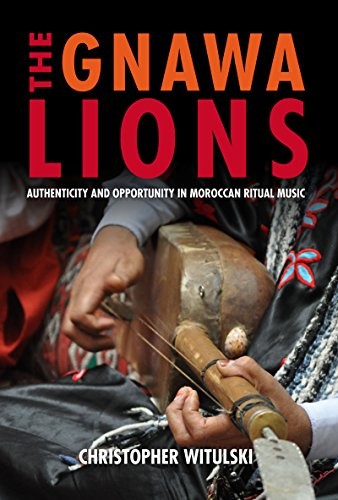
The Gnawa Lions: Authenticity and Opportunity in Moroccan Ritual Music
Witulski, Christopher · 2018 · Indiana University Press (Public Cultures of the Middle East and North Africa)
ISBN: 978-0-253-03675-9
The only book-length ethnography of Gnawa music focused on Fez and the festival economy's effects on ritual practice. Establishes Fez as a fourth Gnawa centre alongside Essaouira, Marrakech, and Casablanca, and reads the brotherhood through the tension between sacred lila practice and the world-music marketplace.
Full summary
Nine chapters tracking how Fez Gnawa maâlems negotiate the demands placed on them by tourism, festivals, and global recognition. Witulski's central concern is authenticity-as-claim — how Gnawa practitioners assert ritual authority when festival economies redirect their music towards entertainment. Chapter 3 (African Routes and Sufi Roots) lays out the dual-origin framing; Chapter 6 (Light Rhythms and Heavy Spirits) and Chapter 7 (Fighting New Demands) develop the festival-economy critique. Three of nine chapters had prior journal publication (Ch. 4 in JNAS 2016a, Ch. 6 in Ethnomusicology Forum 2016b, Ch. 7 in Ethnomusicology 2018).
Used as: Source for the Fez regional thread on /research/gnawa, the festival-economy editorial frame, and Witulski's authenticity argument across the maâlem profiles.
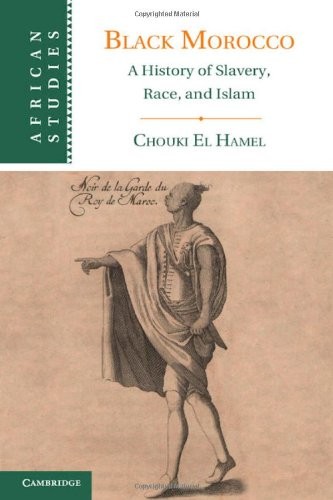
Black Morocco: A History of Slavery, Race, and Islam
El Hamel, Chouki · 2013 · Cambridge University Press (African Studies Series 123)
ISBN: 978-1-107-02577-6
The historical / political grounding for the trans-Saharan slave-trade origins of the Gnawa. Chapter 8 is the canonical scholarly treatment of Gnawa origins, etymology, and self-identity; Chapters 3-6 supply the slavery-and-state history that frames it. Author has direct fieldwork with the Gania and Soudani families (named interview with Mokhtar Gania, Essaouira, June 2005).
Full summary
Eight chapters across two parts. Part One reads slavery, race and concubinage through the Islamic discourse — Qur'an, Hadith, Maliki legal practice. Part Two follows the internal African diaspora into Morocco: the trans-Saharan trade routes, Mawlay Isma'il's racialised 'Abid al-Bukhari project (1672), the political career of the Black Army, the abolition, and (Ch. 8) the Gnawa as the surviving mystic order. El Hamel resolves the long-running debate on the etymology of 'Gnawa': it is most likely from the Berber word gnawi (black man) attested from at least the 1140s (az-Zuhri), not from medieval Ghana (Pâques). The 1130 Almoravid battle of Aghmat — where 3,000 'Jnawa' soldiers were killed — pushes the institutional Black-African presence in Morocco to the 12th century, well before the Songhai (1591) or 'Abid al-Bukhari (1672) milestones.
Used as: Source for the Origins section of /research/gnawa (etymology, 1130 Aghmat battle, named ancestor groups), the Boubker Gania bio on /maalems, and editorial corrections (Pâques Ghana etymology, hajj vs ziyara distinction).
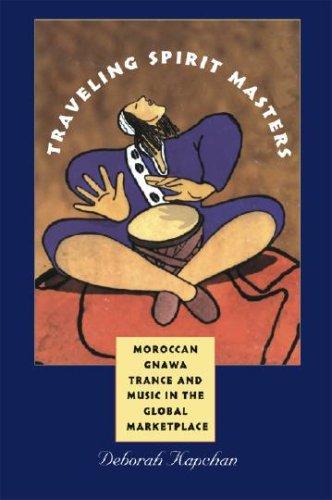
Traveling Spirit Masters: Moroccan Gnawa Trance and Music in the Global Marketplace
Kapchan, Deborah · 2007 · Wesleyan University Press
ISBN: 978-0-819-56852-6
First English-language monograph on Gnawa, with two decades of fieldwork on trance, embodiment, and the music's global circulation.
Full summary
Kapchan, a folklorist and performance-studies scholar, draws on more than twenty years of participation in lila ceremonies and travel with maâlems on the world-music circuit. The book is at its strongest on the *body* — gesture, breath, the sensorium of the trance state — and on the cross-Atlantic collaborations (with African-American jazz musicians, French electronic producers) that have shaped Gnawa's global voice without simply secularising it. Kapchan reads the festival economy as a cultural marketplace where trance is repackaged, but argues the practice has been adapting to new audiences for far longer than that frame suggests.
L'univers des Gnaoua
Chlyeh, Abdelhafid (ed.) · 1999 · Éditions La Pensée Sauvage / Éditions Le Fennec (Maroc). Translations by Régina Keil-Sagawe
ISBN: 978-2-859-19153-5
The canonical French-language essay collection on the Gnawa, published in 1999 alongside the founding of the Essaouira Gnaoua Festival as a state-sanctioned academic companion to it.
Full summary
Edited by Moroccan scholar Abdelhafid Chlyeh. Gathers chapters from Antonio Baldassarre, Chlyeh himself, Mohamed Mahdi, Hassan Amraoui and others. The acknowledgements name André Azoulay (counsellor to King Hassan II and architect of the Essaouira festival), ambassadors Herwig Bartels and Lucio Guerrato, and the Essaouira municipality — locating the volume as part of the late-1990s state-supported revaluation of Gnawa music. Baldassarre's chapter 'Musique et danse des Gnawa: la lila/derdeba comme hypertexte' is the French companion to his 1986 Italian Culture Musicali essay, and adds an analytic frame (setting/dispositif, niya, feraja) the Italian original keeps implicit.
Used as: Source for the lila-as-hypertext analytic frame and the late-1990s festival-era reception context on /research/gnawa.
Les Gnaoua du Maroc — Itinéraires initiatiques, transe et possession
Chlyeh, Abdelhafid · 1998 · Éditions La Pensée Sauvage / Éditions Le Fennec (Maroc)
Canonical French-language monograph on Gnawa initiation and possession, with unique focus on the female ritual leaders (voyantes-thérapeutes, chouwafa, arifa) and three named practitioner profiles (the maâlem Abdeltif and the seers Zineb and Mina).
Full summary
Eight chapters built from Chlyeh's fieldwork with Gnawa practitioners in Marrakech and Essaouira, initiated by the late Lala Zineb (a seer who brought Chlyeh into the research). Distinctive contribution: three chapters on the voyantes-thérapeutes — the women who organise and officiate the lila — a role the broader literature treats lightly. Includes a complete répertoire of the Gnawa song cycle (Annexe I) and a summary table of the sacred portion of the Lila de derdeba (Annexe II), plus cartographic annexes (Annexe III) of Gnawa locations.
Used as: Source for the female-ritual-leader thread on /research/gnawa, the répertoire cross-check, the location maps, and an expanded set of glossary entries (chouwafa, arifa, aouicha, etc.).
La religion des esclaves: recherches sur la confrérie marocaine des Gnawa
Pâques, Viviana · 1991 · Bergamo: Moretti & Vitali
Older French anthropology of the brotherhood — heavily symbolic, occasionally over-claiming, but the source of vivid ritual descriptions later writers cite.
Full summary
Pâques (1920–2007) was a French anthropologist whose long career in West and North Africa produced this monograph alongside her wider work on the 'cosmic tree' as a structuring symbol across Saharan and sub-Saharan religious life. *La religion des esclaves* applies that symbolic-anthropology lens to the Gnawa: the guembri is not just an instrument but a 'companion', a 'living genie', the focal point of an ordered cosmology. Sum cites it for the ritual descriptions of how the guembri is consecrated, fed incense, sprinkled with milk and orange-water before each lila. Read with care — Pâques's interpretive ambition sometimes outruns the evidence she presents — but the descriptive material is rich and well-observed.
Dissertation(2)
Music of the Gnawa of Morocco: Evolving Spaces and Times
Sum, Maisie · 2012 · PhD dissertation, University of British Columbia
The most exhaustive structural account of the contemporary Saouiri repertoire — suites, krakeb patterns, pitch sets, and Maâlem Abdallah's measured tunings.
Full summary
Five years of fieldwork with the Gania family of Essaouira (Maâlems Mahmoud, Mokhtar, and Abdallah, plus the moqaddema Zaida) yield a granular structural account of the lila and its repertoire. Sum documents the eight ritual suites and their succession, names every piece her teachers play, and gives each a Q-pattern, periodicity, and pitch-set analysis. Two figures are load-bearing for this site: Figure 4.4 (the cipher → string/position mapping that lets ciphers and tabs translate cleanly) and Figure 4.5 (three measured tunings of Maâlem Abdallah, with cents deviations from tempered pitch). The dissertation's larger argument is that contemporary Gnawa music is shaped by the tension between sacred lila practice and secular festival/touring contexts — a frame that names what the music is responding to without reducing it to either pole.
Used as: Drives /repertoire (suites, pieces), /research/gnawa (Q-patterns, scales, tunings), and the Sum tuning presets in the tuner.
Musicking Moves and Ritual Grooves Across the Moroccan Gnawa Night
Fuson, Tim Abdellah · 2009 · PhD dissertation, UC Berkeley
Berkeley counterpart to Sum, focused on the lila as performed in Marrakech and Rabat — and Sum's main cross-citation partner on terminology and rhythmic structure.
Full summary
Fuson did long apprenticeships with Marrakech-school maâlems and writes from inside the practice. His dissertation analyses the lila as a continuous sequence of musical and ritual transformations across the night, where 'musicking moves' (the term he borrows from Christopher Small) and 'ritual grooves' co-produce the trance state. Sum's dissertation cross-references Fuson on essentially every contested term: she uses *oum* for the short ostinato motive while Fuson uses *mwima* (literally 'little mother'); she calls the krakeb patterns *Q1* and *Q2* while Fuson calls them the 4-stroke and 3-stroke patterns. Fuson is also the source for several footnoted observations about regional differences and the Hamdushiya borrowing that Sum develops further.
Article(6)
Gnawa Mirror: Race, Music, and the 'Imperialism of Categories'
Aidi, Hisham · 2023 · International Journal of Middle East Studies (Cambridge University Press). Open Access, CC BY 4.0
Genealogy of a century of Western and Moroccan scholarship on Gnawa music — Westermarck 1899, Pâques 1964, Coon 1930s, McKay 1928–34, Randy Weston 1972, Nass El Ghiwane, through the recent Kapchan / Witulski / Becker / Ciucci / El Hamel wave. Frames recent American writing in terms of the 'imperialism of categories' (Rudolph).
Full summary
Aidi (Columbia, Institute of African Studies) reviews four recent books — Becker (Blackness in Morocco), Ciucci (The Voice of the Rural), El Hamel (Black Morocco), Witulski (The Gnawa Lions) — but the essay's intellectual scaffolding stands on its own as a survey of how Gnawa music has been theorised across the 20th and early 21st century. Useful for the project as both a finding aid (which books to acquire) and an editorial check: Aidi's warning that the contemporary categorising impulse (Black vs. Arab, Sufi vs. African, ritual vs. festival) continues colonial-era classificatory habits even when deployed to dignify Gnawa.
Used as: Source for the intellectual-history thread on /research/gnawa and a guiding caution for the site's editorial voice on origins and identity.
Spirits of displacement: Gnawa rituals and gentrification in Casablanca
Portelli, Stefano · 2023 · Focaal — Journal of Global and Historical Anthropology, 1–15. Open Access, CC BY-NC-ND
Urban-anthropology fieldwork on the Casablanca Gnawa: maps where the brotherhood lives (the Derb Gnawa quarter inside the walled medina) and how mega-projects — Hassan II Mosque, Morocco Mall, Marina Shopping, Avenue Royale, Trémie des Almohades — are pushing them out.
Full summary
Spring 2019 fieldwork centred on Casablanca's walled medina and the 'Derb Gnawa' quarter where Gnawa houses concentrated from the 1930s onwards (the first crew arrived from Marrakech then). Portelli reads Casablanca's gentrification as a rewriting of the sacred geography of the city — corporate mega-projects branded as religious continuity (Trémie des Almohades named after a Berber dynasty, the underground megaphone Qur'an system) over a pre-existing pattern of vernacular shrines, qobbat, and Gnawa houses. The Gnawa appear repeatedly as both displaced from those spaces and contracted to bless the new ones — performing at the Marina Shopping Mall inauguration alongside acrobats and clowns. Names a Casablanca network (Hassan Sansi, Hassan Tiger, Mohamed Guchi) of practitioners we don't yet profile.
Used as: Source for the Casablanca / Tréq Beidaoui regional section of /research/gnawa and the Derb Gnawa glossary entry.
The sersera of the guembri: anthropological approach to the device in the context of Gnawa diasporas in Brussels and Morocco
Hanáková, Martina; Dobbelaere, Itzana & Sechehaye, Hélène · 2016 · Kwartalnik Młodych Muzykologów UJ (Jagiellonian University), Issue 3(30), pp. 7–27
Detailed account of the sersera — the detachable metal-loop jingle that traditionally added a high shimmer to the guembri's bass — and the only published study to ask makers and players why it has fallen out of use.
Full summary
Three authors (Hanáková at Masaryk, Dobbelaere at Jean Monnet, Sechehaye at Université libre de Bruxelles) interview four m'allems in Brussels and players and a luthier in Marrakech and Rabat about the *sersera*, a removable idiophone made of metal loops fixed around the rim of a metal sheet that slides into a slot at the end of the guembri's neck. Acoustically, the sersera shimmers in the 1000–3000 Hz band the ear hears best, helping the lute cut through krakeb and singers — a 'cold' against the wood-and-skin 'warm', as Maâlem Rachid puts it. The paper documents that the device is now rarely mounted, even by makers who still build it, and gives the m'allems' own reasons: amplification has replaced its volume function, the krakeb cover its rhythm and metallic timbre, and outdoor secular performance contexts make it inaudible. The paper also gathers the symbolic readings — warm/cold complementarity, slave-chains, the three living kingdoms (animal/vegetal/mineral) — and traces the sersera back through Delacroix's 1832 sketches and Georg Høst's 1760 description from Essaouira.
Used as: Drives the construction-vocabulary block in §01 Instrument and the dedicated Sersera panel.
The sersera of the guembri: anthropological approach to the device in the context of Gnawa diasporas in Brussels and Morocco
Hanáková, Martina; Dobbelaere, Itzana; Sechehaye, Hélène · 2016 · Kwartalnik Młodych Muzykologów UJ 30 (3/2016), 7–27
The only published study focused specifically on the sersera — the detachable metallic rattle at the top of the guembri's neck — and on the brotherhood's instrumental vocabulary more broadly.
Full summary
Field-based study combining the Brussels Gnawa diaspora with interviews in Marrakech and Rabat. Documents the sersera (also called *risha* 'feather', or *sarsala* / *lisān* 'tongue') as a custom-made metallic timbre-modifier whose use is becoming obsolete. Compiles the historical evidence — Høst 1760, Delacroix 1832, Farmer 1928, Pâques 1991, Baldassarre 1999, Claisse 2003 — and situates the device within the West African plucked-lute tradition documented by Eric Charry. The article also gives the broadest published vocabulary for the guembri itself (wajh, awtar, mastara, l-fumm, makhzina, hmmal, itkellmu, hajhuj — the last confirming the instrument originally had two strings).
Used as: Source for the §01 Instrument section of /research/gnawa, the sersera glossary entry, and the guembri parts vocabulary.
Observations on Gnawa healing in Morocco: Music, bodies and the circuit of capital
Schaefer, John P. R. · 2015 · Performing Islam 4(2), 173–182. Intellect Ltd
Healing-economy ethnography of one Tangier lila at Dar Gnawa (Abdellah El Gourd's home/museum). Documents the contract negotiation that turns the ceremony into 'a kind of spiritual investment' and the post-2007 gentrification context (Tanger-Med port, old-port tourism redevelopment) reshaping Tangier Gnawa institutions.
Full summary
Autumn 2006 fieldwork during Sha'ban at Dar Gnawa in Tangier. Schaefer documents the contractual negotiation between a sick supplicant, a muqaddima, and the m'allem — Abdellah El Gourd — that gives the lila its economic shape. The article frames Gnawa healers as 'working-class entrepreneurs in a neo-liberal economy', following David Harvey's reading of capital. A 2010 return finds Dar Gnawa being formalised — board of directors, moving from Abdellah's home to a public space — as Tangier itself gentrifies around the Tanger-Med port redevelopment.
Used as: Source for the Tangier regional thread, biographical detail on Abdellah El Gourd's Dar Gnawa, and the ceremony-economy editorial frame.
La musica dei gñawa del Marocco
Baldassarre, Antonio · 1986 · Culture Musicali — quaderni di etnomusicologia, 10/11 (Etnomusicologia italiana fuori di casa). La Casa USHER
The longest-form pre-Sum academic treatment of Gnawa music. Seven years of fieldwork (1977–1984) with named maâlems including Mahmud Ghenia (Mahmoud Guinia), 'Amida Bussu (Hmida Boussou), Paqa 'Abdrahman Kiroush (Abderrahman Paca), and Said Burki (Said Elbourki) — all profiled on /maalems.
Full summary
Italian-language ethnomusicology essay across the full Gnawa music system: brotherhood mythology (Sidna Bilal), trans-Saharan migration history (the 1591 fall of Songhai to Ahmed al-Mansour, Moulay Ismail's 'Abid al-Bukhari guard 1672–1727), the instruments (qraqèb, t'bal with sahla/tarrash stick taxonomy, gambri/hejhuj/dìn-dnà/santir), and the cosmology of the *khla* (the 'third hidden world') and the *mlouk*. Predates Sum 2012 by a generation and grounds her structural work with a wider ethnographic frame. Baldassarre is the same author behind the Al Sur 'Maîtres du Guembri Vol. IV' liner notes; the field connections to specific maâlems are first-hand. The French companion essay in Chlyeh 1999 ('Musique et danse des Gnawa: la lila/derdeba comme hypertexte') reframes the same material around setting/dispositif and the lila-as-hypertext.
Used as: Source for the Origins, Cosmology, and Instrument sections of /research/gnawa, the brotherhood vocabulary in /glossary (dìn-dnà, khla, bu'lilah, bu' ganga, sahla/tarrash, majdhub, 'Abid al-Bukhari), and enriched bios for the named maâlems on /maalems.
Proceedings(1)
Interval structures in Gnawa music
Vanelli, Lorenzo · 2017 · Proceedings of FMA 2017, pp. 37–43
Measures the seven-note Gnawa scale as cents intervals from the dir tonic. Names a raised neutral 2nd (~164¢) and raised major 6th (~923¢) as Gnawa-specific microtonal identity markers.
Full summary
Five months of fieldwork (2016–2017) with maâlems including Khalid Amenhouce (apprentice to the late Mahmoud Guinia), Yassine Boubker, and Azouz Soudani, plus the luthier Mahmoud. Vanelli measures the intervals from the dir tonic across all seven fingered positions on two instruments, giving the Gnawa scale a precise cents profile (Table 1). Two intervals — 163.9¢ at the dir's first position, 923.2¢ at the tehtia's second — sit between tempered scale steps and are not tuning errors: musicians reproduce them deliberately. Vanelli's broader argument is that these microtones function as identity markers tied to the brotherhood's West/Central African origins, and that they flatten to a tempered Dorian when commercial recordings (e.g. Hamid El Kasri's *Saha Koyo: Jazz Gnawa*, 2006) are forced to follow keyboard accompaniment.
Used as: Drives the interval-structure panel on /research/gnawa (Vanelli Table 1).
Recording(2)
Gnawa: Music and Beyond
Willemont, Jacques (dir.); Pâques, Viviana (scientific direction) · 2012 · Espaces (DVD, 58 min, EN/FR with Arabic/EN/FR subtitles)
Pâques's final project, posthumously released. Documentary built around interviews with the moqqadem Al Ayachi (and his moqqadema wife Mina) at Tamesloht near Marrakech, with Pâques's interpretive commentary throughout.
Full summary
58-minute documentary directed by Jacques Willemont under Viviana Pâques's scientific direction (Pâques died in 2007). Three content streams: interview footage with Al Ayachi (the moqqadem), documentary footage of a full derdeba, and Pâques's interpretive analysis derived from her decades of work at Tamesloht. Witulski's 2019 review for *Visual Anthropology* describes it as 'the fruit of the scientific approach Viviana Pâques inherited from the French symbolic school founded by Marcel Griaule in the 1950s'.
Used as: Source for the Al Ayachi / Mina / Milouda ritual-figure references, the erqsu / mida vocabulary, and the Pâques–Griaule French-symbolic-school lineage on /research/gnawa.
Gnaoua Lila Vol. IV — Les Maîtres du Guembri / The Masters of Guimbri — Les Suites du Rouge & du Vert / The Red & Green Suites
Baldassarre, Antonio (liner notes) · 1996 · Al Sur (CD + bilingual booklet, FR/EN)
First fully-attributed published source the project draws lyrics from. A complete Lila led by M'allem Sam and M'allem Hmidah of Casablanca, captured midnight-to-dawn, with French and English liner-note translations of the song cycles for the Red (Bel Ahmar) and Green (Khder Chorfa) suites — plus a Casablanca-school 'Tréq Beidaoui' framework that runs parallel to Sum's Saouiri analysis.
Full summary
The fourth volume in Al Sur's Gnaoua Lila series, recorded with the two deans of Casablanca Gnawa — M'allem Sam (Mohammed Zourhbat) and M'allem Hmidah (Ahmed Boussou) — alternating leadership of the seven-suite ritual. The 35-page booklet, written by Baldassarre, gives bilingual transcriptions and translations of the song cycles for Bel Ahmar (the Red Lord — slaughterhouse / blood / Pacha Hammou) and Khder Chorfa (the Green of the Prophet's descendants), plus a single 'Samaoui' (Sky) song. The booklet also lays out the Casablanca-school's seven-station Tréq Beidaoui (path of the white) — distinct from the Saouiri 8-mhallat order Sum documents — and includes biographical sketches of Sam (b. Marrakech 1925) and Hmidah (b. Casablanca 1939), each with full apprenticeship lineage. The first source we have where the lyric and structural data are both vetted by a named scholar against named maâlems.
Used as: Drives the Bel Ahmar / Khder Chorfa lyric variants and the M'allem Sam / M'allem Hmidah maâlem profiles.
Cited but not held(14)
Works our primary sources cite that we haven't acquired ourselves. Listed here so it's clear when our claims stand on second-hand citation. See issue #59 for the acquisition watch-list.
Charry, Eric (1996). Plucked Lutes in West Africa: an Historical Overview. The Galpin Society Journal 49, 3–37.
Establishes the West African plucked-lute tradition the guembri belongs to. Cited by Sechehaye et al. 2016.
Charry, Eric (2000). Mande Music. Chicago: University of Chicago Press, pp. 128–132.
Canonical reference for the Sahelian Mande lute prototypes of the guembri. Cited by Becker 2011 and Sechehaye et al. 2016.
Pâques, Viviana (1964). L'Arbre cosmique dans la pensée populaire et dans la vie quotidienne du nord-ouest africain. Paris.
First landmark academic treatment of slavery and religious practice in northwestern Africa. The igri ignawen Tamazight etymology comes from here.
Pâques, Viviana (1991). La Religion des esclaves: recherches sur la confrérie marocaine des Gnawa. Bergamo: Moretti & Vitali.
Detailed possession-cult study. Source for the 64-rings-on-sersera canonical count (p. 284).
Pouchelon, Julien (2015). Les Gnawa du Maroc: intercesseurs de la différence? Étude ethnomusicologique, ethnopoétique et ethnochoréologique. Paris.
Recent French ethnomusicology dissertation on Gnawa. Cited by Sechehaye et al. 2016.
Claisse, Pierre-Alain (2003). Les Gnawa marocains de tradition loyaliste. Paris.
Anthropomorphic reading of the guembri — the sersera as the instrument's tongue (lisān / sarsala).
Ennaji, Mohammed (1998). Serving the Master: Slavery and Society in Nineteenth Century Morocco. Trans. S. Graebner. New York: St Martin's Press.
The 20,000-slaves-per-year figure and broader 19th-c. slavery history cited by Becker 2011.
Majdouli, Zineb (2007). Trajectoires des musiciens Gnawa: Approche ethnographique des cérémonies domestiques et des festivals de musique du monde. Paris.
Source for the 'most coveted place is in front of the guembri' field-quote.
Farmer, Henry George (1928). A North African Folk Instrument. Journal of the Royal Asiatic Society of Great Britain and Ireland, Vol. 1, p. 28.
Earliest English-language scholarly description of the guembri; mentions early forms without the sersera hole.
Høst, Georg (1781). Nachrichten von Marokos und Fes, im Lande selbst gesammelt, in den Jahren 1760 bis 1768. Kopenhagen.
1760 first written description of the guembri, by the Danish consul in Essaouira.
Westermarck, Edward (1899). The Nature of the Arab Ginn, Illustrated by the Present Beliefs of the People of Morocco. Journal of the Anthropological Institute 29, no. 3/4.
Foundational early ethnographic mention of the Gnawa, the Sus-origin hypothesis. Cited by Aidi 2023 and Becker 2011.
Ames, D. W. (1971). Glossary of Hausa Music and Its Social Contexts. Chicago: Northwestern University Press.
Source for the qraqab / Hausa sambani etymology.
Kapchan, Deborah (2007). Traveling Spirit Masters: Moroccan Gnawa Trance and Music in the Global Marketplace. Wesleyan University Press.
Foundational ethnography of Gnawa in the global marketplace. Cited across El Hamel 2013, Aidi 2023, Becker 2011. Not yet in our pubs/ — see issue #59.
Hell, Bertrand (2006). L'expérience du corps et des émotions dans les cultes de possession. In Ysé Tardan-Masquelier (ed.), Le Corps médiateur. Paris: Dervy, 87–106.
Cited by El Hamel 2013 as the specialist on Gnawa spirit possession.
Attribution & provenance
Maâlems & recordings
Biographical entries and discography links on /maalems and /repertoire are compiled from public sources — Spotify, YouTube, Bandcamp, festival press kits, Wikimedia, and the obituary press. Each individual entry links back to the source it was drawn from.
Illustrations
Maâlem portraits flagged as ai-illustration were commissioned for guembri.com from public photographs, then processed through generative tools into a consistent painted style. Photos from Wikimedia Commons or festival press kits keep their original credit and licence on the maâlem profile.
Open access
The PDFs we work from are bundled in the project's pubs/ folder when their licence permits. Where it doesn't, the entry above links to the publisher.